
Begin with a scene
Where were you, what were you doing and what do you remember? A sentence about a rainy café, a mutual friend's kitchen or a missed train gives the reader somewhere to begin. Avoid opening with a broad claim about destiny if a real detail can do the work.
Pick three turning points
Use the first meeting, a moment when the relationship changed and the step toward marriage. You can include travel or ordinary routines between them, but keep the sequence clear. Dates are helpful when they add context, not as a compulsory list.

Write both people into the story
Check that the account gives room to both perspectives. If you remember the first date differently, that can become a short paired anecdote. Ask your partner to edit any quotation attributed to them.
An example to adapt
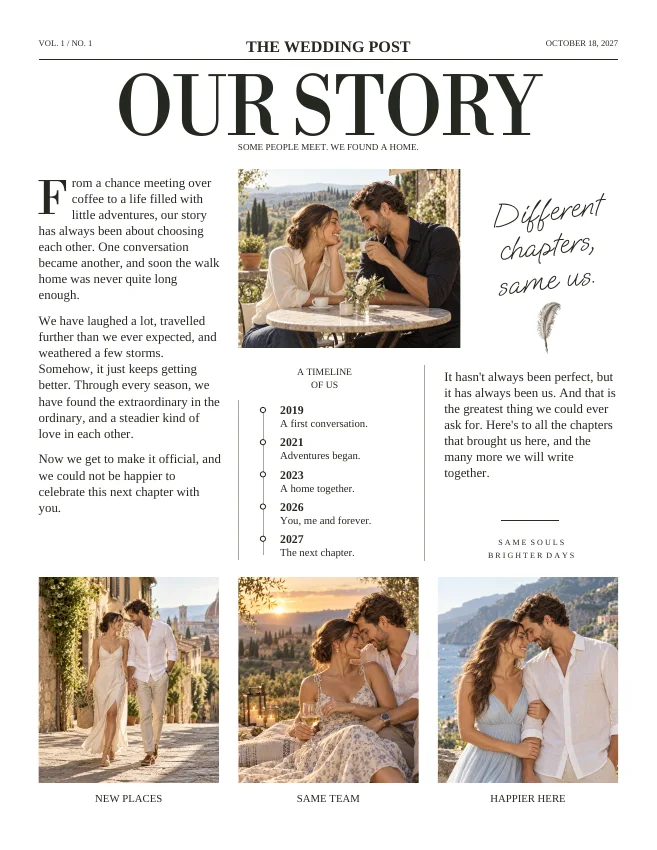
We met at a friend's dinner and spent most of the evening arguing, kindly, about the best way to spend a Sunday. One coffee became a weekly ritual. Since then, our map has grown to include new cities, a shared home and the same favorite café. Today feels like another beginning, with all our favorite people here to see it. Replace every general moment with one that belongs to you.
Prompts that find the real story
| Moment | Ask each other | Useful detail |
|---|---|---|
| First meeting | What do you remember differently? | A place, a line or a small mistake |
| Early days | When did ordinary time become special? | A repeated routine |
| Turning point | When did you start thinking as a team? | A choice you made together |
| Today | What are you looking forward to? | A concrete shared hope |
Edit for the page
Aim for a focused first draft, then shorten until it fits comfortably at a readable size. Remove repeated milestones and keep one strong ending. Read it aloud together; if it feels like a wedding brochure rather than your own story, use simpler words.
A before-and-after story edit
First draft: We met a few years ago and immediately got along. We had lots in common, went on many adventures and fell in love. Now we cannot wait for the future.
More personal: We met when a mutual friend insisted we would get along. Our first coffee became a walk, then dinner, then a very late train home. Since then, our favorite adventures have ranged from a first apartment to getting lost on a weekend road trip. The best part has stayed the same: finding someone who makes ordinary days feel like a shared adventure.
The second version is still a fictional example, but it shows the technique: replace broad claims with a small sequence of events. Your version should use details that actually happened.
Let both voices be present
Write a rough version independently, then compare the moments each of you chose. The overlap usually points to the heart of the story. A different memory can become a charming detail if both people are comfortable sharing it.
Read the combined draft together and agree on what stays private. You do not owe readers the complete history of your relationship. Keep the tone generous toward yourselves and everyone mentioned. End with the life you are building or the people gathered around you, so the story leads naturally into the wedding rather than stopping at the proposal.
ON THE PAGE
See how it comes together.
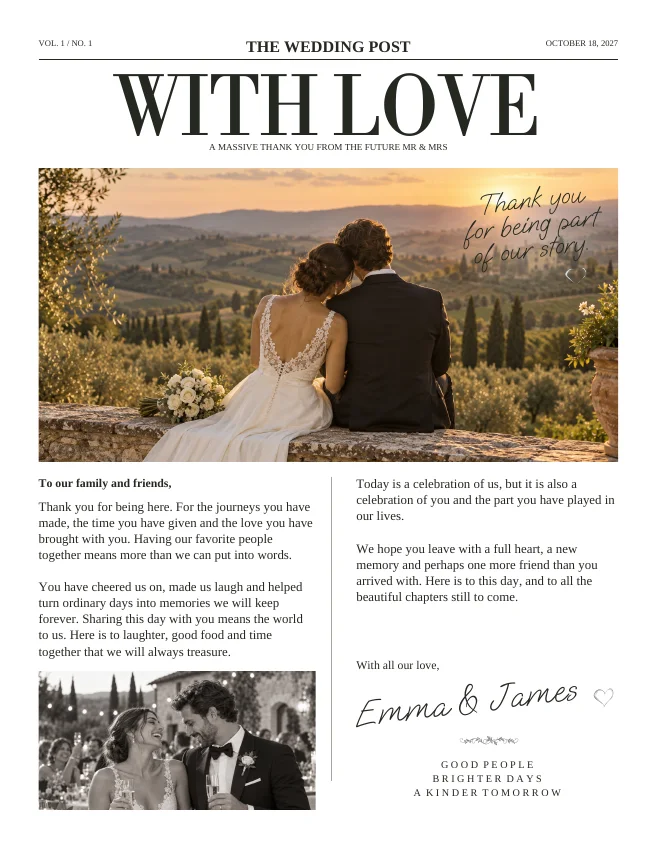
Actual sample pages from Editorial Classic. Open a page to explore the PDF. Replace the fictional details and sample photographs with your own.
KEEP IT SIMPLE
Your next steps
- Open with a real moment
- Choose three turning points
- Include both perspectives
- Read aloud before placing it
GOOD TO KNOW
A few things you might be wondering.
Should we write in first or third person?
Either can work. First person often feels more intimate; third person can support an editorial tone. Stay consistent within the feature.
What if our story is very ordinary?
Ordinary details are often the most personal. A shared routine can tell readers more than a dramatic event.